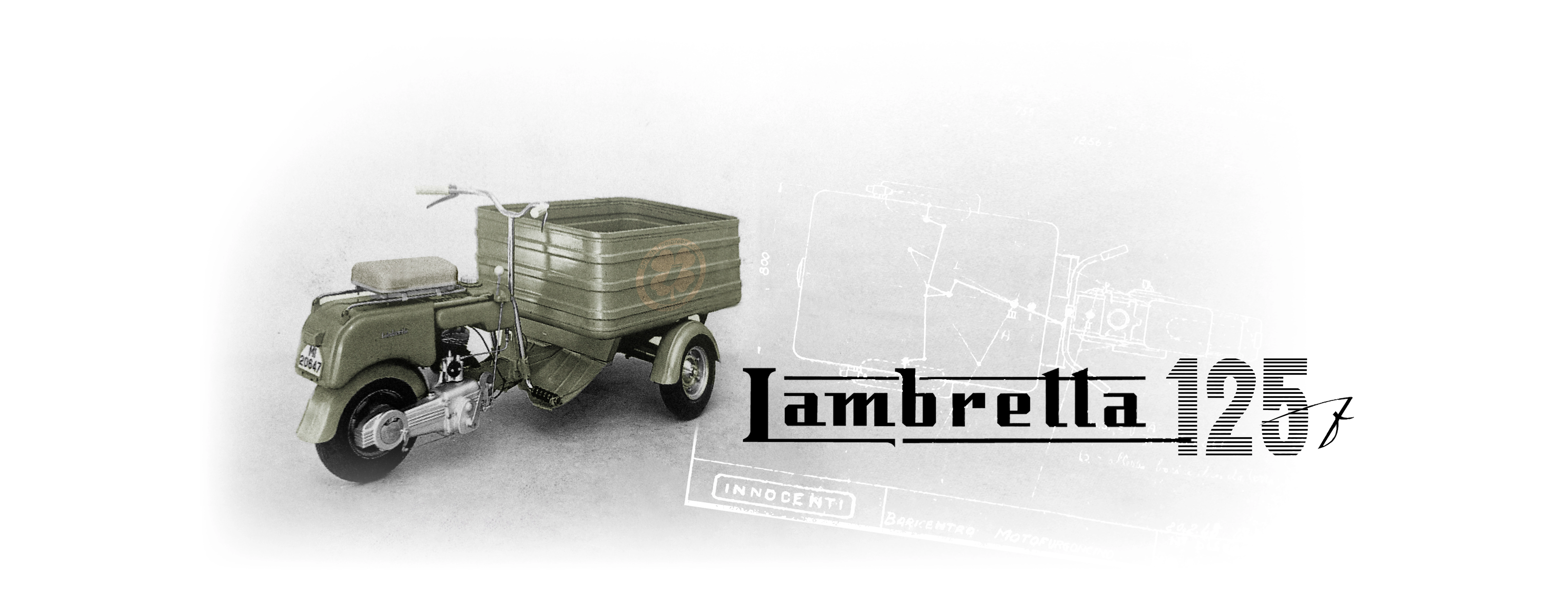
Experiment 4 / Type 12
Experiment 4 was Innocenti’s advanced prototype study for a light commercial three-wheeler, developed during 1947–1948 as part of the company’s post-war exploration of utility vehicles. Although it appeared in period brochures and promotional material, and was publicly displayed, Experiment 4 never entered mass production. Only a small number of examples progressed to this late stage of development.
The prototype is significant not as a styling exercise, but as an engineering programme focused on load carrying, stability, and practical usability, addressing problems fundamentally different from those of a passenger scooter.
Physical existence and public display
Surviving photographic and documentary evidence confirms that physical examples of Experiment 4 existed by 1948. At least four examples were displayed at the Milan Fair of 1948, shown alongside the Lambretta M125. Contemporary accounts indicate that at least one of these vehicles was fully functional. It is further documented that customers who placed orders for the vehicle at the exhibition did not ultimately receive an “F” as shown in the sales literature, but were instead supplied with the production Furgoncino B125. This demonstrates that Experiment 4 had advanced beyond internal experimentation and into a stage suitable for public demonstration, while also marking the point at which the project transitioned toward the B125 as the realised commercial outcome. (Source: Bruno Strigini)
General layout and vehicle concept
Experiment 4 adopts a three-wheeled layout with two front wheels supporting a forward load compartment and a single rear wheel driven by an M125 engine. The configuration places the primary payload over a wide, stable front axle while isolating propulsion at the rear. The design prioritises low-speed stability, predictable steering under load, and compact overall dimensions suited to urban commercial use.
Articulation and structural design
A factory drawing dated 12 April 1947 identifies a forged and heat-treated fuso a snodo (articulated pivot shaft), manufactured with controlled tolerances. This drawing represents the earliest documented technical evidence of what would become the Furgoncino B125 programme. The presence of this component demonstrates that articulation was deliberately engineered at an early stage, allowing relative movement while transmitting load between the two main sections of the vehicle. This confirms that the project had progressed beyond conceptual layouts into structured mechanical development focused on durability and functional integrity.
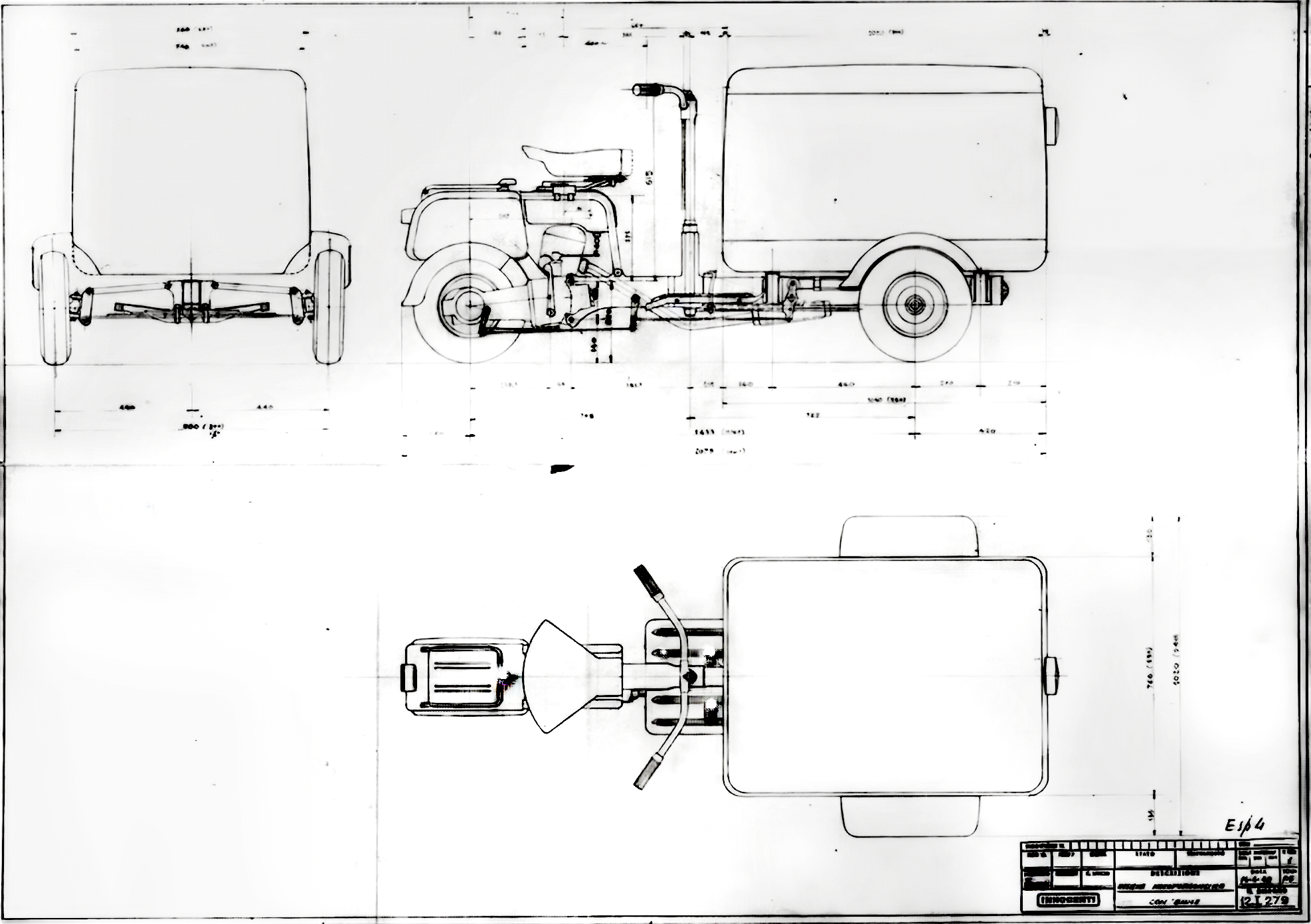
Side, front, and plan views of the Experiment 4 motofurgoncino, illustrating the two-wheel front load module, single rear driven wheel, and the articulated connection between the two sections.
Image: Vittorio Tessera
Centre-of-gravity studies
One of the most informative surviving drawings is titled Baricentro Motofurgoncino, documenting centre-of-gravity calculations under multiple operating conditions, including the vehicle empty, with rider, and with payload. These studies show that Innocenti engineers were actively evaluating longitudinal weight distribution and stability across real-world use cases. The careful positioning of the load relative to the front axle and the articulation point reflects a methodical approach to ensuring predictable handling and braking behaviour when laden.
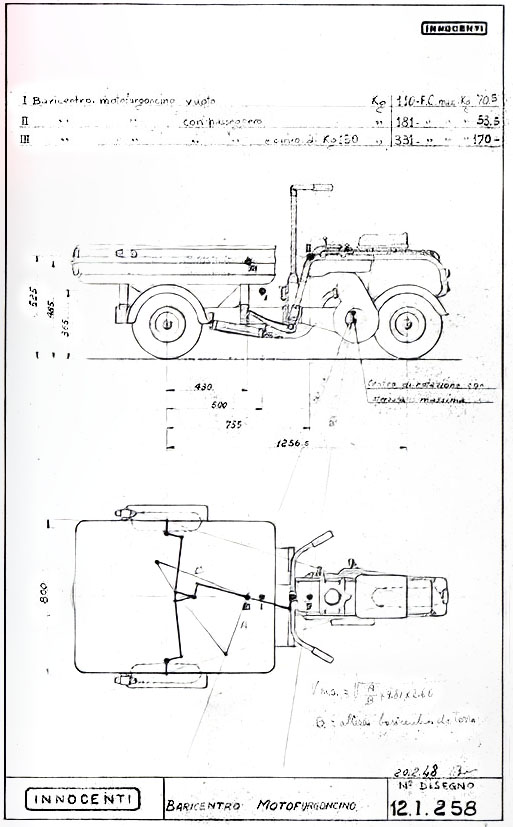
“Baricentro Motofurgoncino” drawing showing longitudinal weight distribution under different operating conditions, including empty, with rider, and with payload.
Image: Vittorio Tessera
Handlebar configurations and ergonomic evaluation
Period material indicates that more than one handlebar configuration was tested during the Experiment 4 programme. The earliest known configuration employed a raised handlebar formed with a double-bend profile, providing increased height and forward reach over the front load body. This geometry improved steering leverage and rider clearance without altering the basic steering-head layout. Later drawings depict alternative arrangements, indicating that ergonomics and control layout were actively evaluated as part of the prototype process. These variations reflect development work rather than inconsistency, and no single configuration can be considered definitive.
Documented development variants
At the design level, at least four iterations of Experiment 4 are believed to have existed, although surviving material allows three distinct variants to be clearly identified. The earliest project, for which no original drawings are believed to survive, appears to have been constructed partly as a wooden mock-up. A second version, documented in a factory drawing dated 20 February 1948, shows revisions to the handlebar design, cooling ducting, footrests, and saddle size. The final known project, identified in a drawing dated 14 April 1948 and explicitly marked “Experiment 4”, introduces further changes to the footrests and braking system, with the saddle standardised to that found on the M125 3rd series. Gearbox actuation details are not fully defined in the surviving documentation.
Proposed production numbering
Innocenti drawing No. 21232, dated August 1947, specifies a proposed numbering system in the event that Experiment 4 entered production. The vehicle would have carried a Type 12 designation, with engine numbers prefixed “M” beginning at 5001, and frame numbers prefixed “T”. This identification numbering mirrors that of the earliest M125 first series (Type 2), found only on the first 70–90 examples. With no known surviving examples of Experiment 4, it can only be speculated that this numbering was implemented on those exposition examples.

Drawing showing example layouts for engine and frame number markings, including the Type designation and the “M” and “T” prefixes beginning at 5001 as specified for the motofurgoncino.
Image: Vittorio Tessera
Summary
Experiment 4 represents a focused attempt by Innocenti to engineer a compact, load-carrying three-wheeler through structured prototype development, incorporating centre-of-gravity analysis, articulated chassis solutions, and iterative ergonomic refinement. Publicly displayed yet never produced, it occupies a distinct position within Innocenti’s experimental history as a fully realised prototype that stopped just short of series manufacture.
Source note
Key elements of the development history linking Experiment 4 to the Furgoncino B125, including the interpretation of factory drawings, Milan Fair accounts, and early commercial outcomes, are informed by the research and archival work of Bruno Strigini. His analysis provides essential context for understanding the transition from the publicly exhibited “F” prototype to the B125 as the realised production vehicle.
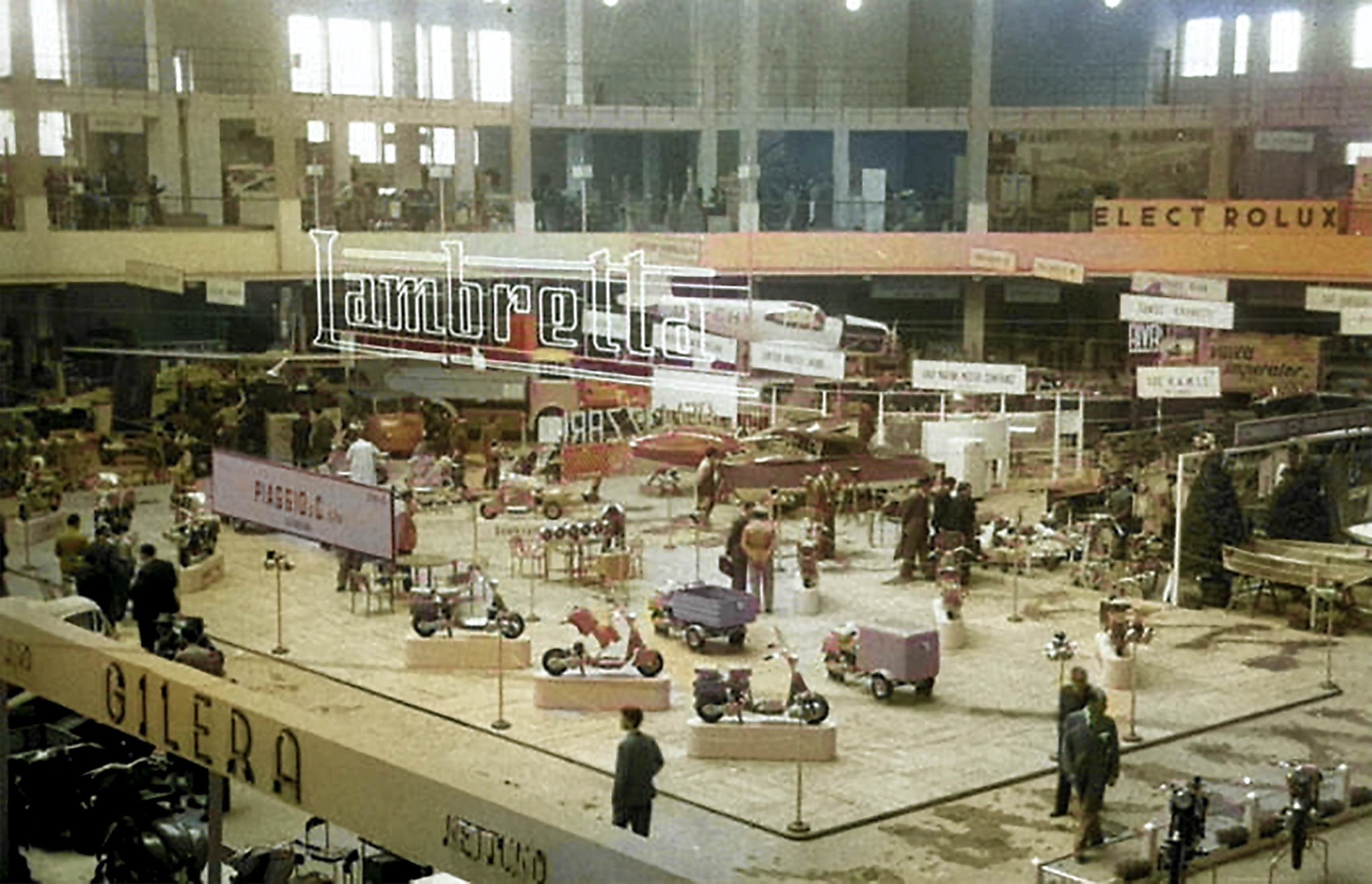
Innocenti’s stand at the 1948 Milan Fair, showing the Lambretta M125 alongside two variants of “Experiment 4,” confirming the physical existence and public display of the prototype during its late development phase.
Image: British Lambretta Archive